Anthropic Academy has grown from 13 free courses at launch to more than 20, covering Claude, Claude Code, the Claude Platform, MCP, and Claude Cowork, and most people still do not know they exist.
There are more than 20 free courses sitting on the internet right now, taught by the company that built Claude, each one ending with a certificate you can share on LinkedIn. A Reddit post sharing an early version of this catalog pulled 2,665 upvotes on r/ClaudeAI. Most people who use Claude every day still have no idea these courses exist.
I'm talking about Anthropic Academy, the official learning platform from Anthropic. It launched quietly in March 2026 with 13 courses and has grown fast since then. As of now it covers everything from using Claude for the first time to running production-grade Claude Code sessions and building Model Context Protocol servers. All free. All self-paced. All with a certificate at the end.
This guide shows you exactly where to find the courses, what each one covers, and which ones to take first depending on your goal.
What Is Anthropic Academy?
Anthropic Academy is the official training hub from Anthropic, the company behind Claude AI. The full course catalog is hosted on Skilljar, a learning management system used by companies like Stripe and Twilio for professional training.
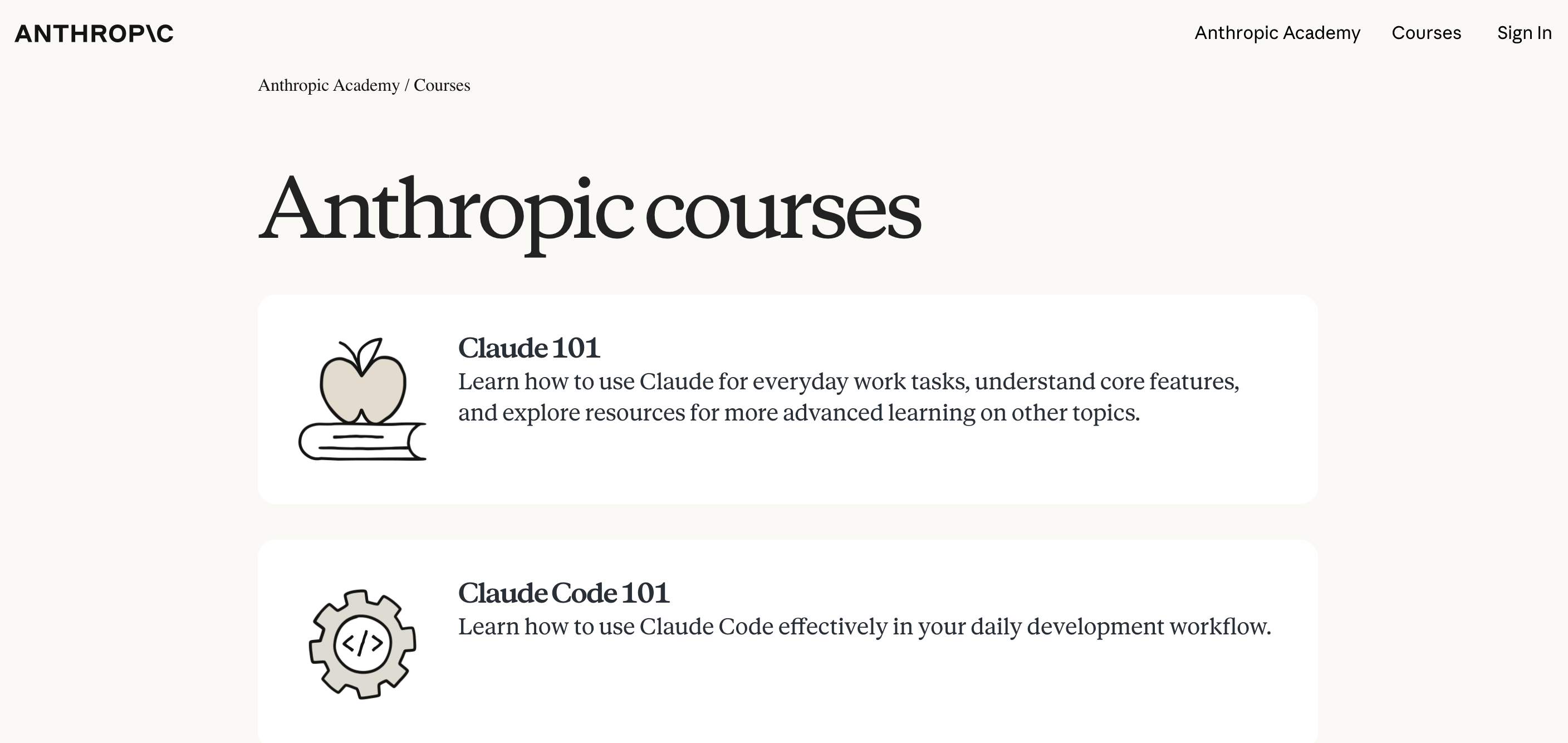
You access it at anthropic.skilljar.com.
Here's what makes it stand out:
- Free. Every course is free. No credit card, no paywall.
- Self-paced. Work through modules on your own schedule.
- Certificate on completion. Each course ends with an assessment. Pass it and you get a shareable certificate.
- No Anthropic account required. You only need a Skilljar account to access the course content.
The courses are built for a wide range of learners. There are beginner tracks for people who have never used AI before. There are developer courses on the Claude API, Claude Code, and Model Context Protocol (MCP). There are business, education, and nonprofit tracks for teams rolling out Claude across an organization.
The Full Course Catalog
Here's a breakdown of what Anthropic Academy currently offers, grouped by who each track is for. I have grouped it by audience instead of listing all 20-plus courses in one long list, because that's the fastest way to find the two or three that actually matter to you.
For Beginners and Business Users
Claude 101
This is the starting point. Claude 101 covers how Claude works, how to write effective prompts, and how to use Claude's key features for daily tasks. It's designed for people who want to use Claude at work without a technical background.
If you're new to Claude, this is where I'd tell you to start. It sets you up to get real value out of the tool immediately. (After this, I'd suggest checking out my guide on how to start using Claude AI as a complete beginner for more practical tips.)
AI Fluency: Framework and Foundations
AI Fluency was developed with professors Joseph Feller and Rick Dakan. It teaches a practical framework for working with AI effectively, ethically, and critically. It's not a Claude-specific course, it's about how to think about and use AI tools in general.
This one is especially good for business owners, managers, and team leads who want to roll out AI tools responsibly. If you're comparing tools and deciding what fits your workflow, you might also find my post on Claude AI vs ChatGPT useful alongside this course. Anthropic also built dedicated AI Fluency variants for educators, students, small businesses, builders, nonprofits, and creative professionals, so pick the one that matches your world.
Introduction to Claude Cowork
Claude Cowork covers Claude Cowork, the hands-on workspace for working with Claude directly on your real files and projects. The course walks through the Cowork task loop, plugins and skills, file and research workflows, and how to steer multi-step work responsibly, so you're productive in your first week. It's a strong pick for non-technical users who want to get more out of Claude in a professional setting.
For Developers and Technical Users
Claude Platform 101
Claude Platform 101 is the newest entry point for developers. It teaches you to build on the Claude Platform from the ground up, whether you've made a few API calls or have only used Claude through a chat window. If you're starting from zero on the developer side, take this one before Building with the Claude API.
Building with the Claude API
If you want to wire Claude into your own apps, websites, or internal tools, Building with the Claude API is the course to take. It's the most comprehensive course on the platform at over 8 hours of content, walking through the full process: authentication, request handling, streaming, tool use, and application design patterns.
This course pairs directly with my deeper guide on how to connect Claude AI to your apps using the Claude API if you want a step-by-step walkthrough after completing the course.
Model Context Protocol (MCP)
MCP, short for Model Context Protocol, is how Claude connects to external tools: databases, file systems, web services, and business apps. Introduction to Model Context Protocol teaches you to build MCP servers and clients from scratch in Python, covering MCP's three core primitives: tools, resources, and prompts. Once you have the basics down, Model Context Protocol: Advanced Topics covers production patterns like sampling, notifications, file system access, and transport mechanisms.
One developer who worked through most of the catalog called the MCP courses "definitely juice that's worth the squeeze, particularly learning STDIO and StreamableHTTP transport protocols." That's a developer speaking, but even if you're not a coder, understanding MCP helps you work with people who are.
Claude Code
Claude Code is Anthropic's terminal-based coding tool, and it now has its own two-course track. Claude Code 101 is built for developers who are either new to software engineering or experienced engineers who haven't yet tried an AI coding agent. It walks through installation, setup across the terminal, VS Code, JetBrains, Claude Desktop, and the web, and the explore-plan-code-commit workflow you'll use on every task.
Once you've got the basics, Claude Code in Action teaches you to run long, hands-off Claude Code sessions you can actually trust: steering, configuring, automating, and verifying the work.
Introduction to Agent Skills and Subagents
Introduction to Agent Skills covers Anthropic's Agent Skills framework, reusable capability files you can add to Claude to give it specialized knowledge and tools. Right alongside it, Introduction to Subagents teaches you to use and create sub-agents in Claude Code to manage context, delegate tasks, and keep your main conversation clean. Both are aimed at developers building with Claude Code or the Claude API who want more powerful, task-specific setups.
For Organizations and Cloud Teams
Anthropic also provides dedicated learning paths for teams running Claude at scale:
- Claude with Amazon Bedrock, a course built as part of an accreditation program for AWS employees, available here.
- Claude on Google Cloud, covering the full spectrum of running Claude on Google Vertex AI, available here.
- Teaching AI Fluency, which trains academic faculty and instructional designers to teach and assess AI Fluency in instructor-led settings, available here.
- AI Capabilities and Limitations, an introductory course on how AI actually works under the hood, available here.
These tracks are worth exploring if you're managing Claude adoption across a team, a school, or a cloud environment.
Is There a Paid Certification Too?
Yes. On March 12, 2026, Anthropic launched the Claude Certified Architect, Foundations (CCA-F), a proctored, 60-question exam that tests whether you can design and ship production-grade Claude applications at enterprise scale. It's closed-book, no AI assistance allowed, and covers agentic architecture, MCP integration, Claude Code workflows, and prompt engineering. It's delivered through Pearson VUE and currently costs $125 per attempt, though the first 5,000 Claude Partner Network employees got it free.
The CCA-F sits above the free Skilljar completion certificates. Those confirm you finished a course. The CCA-F confirms you can actually design a Claude system that holds up in production. If you're building Claude commercially and want a credential that proves your expertise, the CCA-F is the exam to aim for. But for most people reading this, the free Skilljar courses are more than enough to get started and build real, usable skills.
Which Course Should You Take First?
Here's a simple guide based on your goal:
If you've never used Claude: Start with Claude 101. It's short, practical, and gives you the vocabulary you need for everything else.
If you're a business owner or manager: Take AI Fluency next after Claude 101. It helps you think clearly about where AI fits in your business.
If you want to build with Claude: Start with Claude Platform 101, then move into Building with the Claude API. Layer on MCP, Claude Code, and Agent Skills as you grow.
If you're a developer who wants Claude Code specifically: Go straight to Claude Code 101, then Claude Code in Action once you're comfortable.
If you want to learn it all in order: Claude 101, AI Fluency, Claude Platform 101, Building with the Claude API, MCP (intro then advanced), Claude Code 101, Claude Code in Action, then Agent Skills and Subagents.
How to Sign Up
- Go to anthropic.skilljar.com
- Create a free Skilljar account
- Browse the course catalog
- Enroll in the course you want
- Work through the modules at your own pace
- Complete the final assessment
- Receive your certificate and share it on LinkedIn
You do not need a Claude account to take the courses. But if you want to practice what you're learning inside Claude itself, sign up at claude.ai.
My Take
What I love about Anthropic Academy is that it teaches practical skills, not theory. Claude 101 is genuinely useful for someone who has never written a prompt before. The MCP courses go deep enough to be useful for developers building real things. And the fact that every course is free is hard to overlook.
The catalog keeps growing too. It launched in March 2026 with 13 courses. By the time you read this, it's up past 20, with newer additions like Claude Platform 101, Claude Code in Action, and Introduction to Subagents filling gaps the original lineup didn't cover. Anthropic is clearly investing in this.
If you're using Claude, working with AI at your company, or trying to build something with the Claude API, there is at least one course on this list that will save you hours and give you a shareable credential for your LinkedIn profile.
Start at anthropic.skilljar.com and pick the track that fits where you are right now.
Free resource
Recommended Anthropic Academy course order by goal (beginner, business, developer) plus a progress tracker.
Keep reading
More from the blog
View all posts5 min read
What Is Claude Code? A Plain-English Guide for Beginners
What is Claude Code? A plain-English guide to what it does, where you can use it, what you need and how to try it safely, with no coding background.
5 min read
Claude Code for Beginners: Do You Need to Know How to Code?
Claude Code for beginners: do you need to know how to code? A plain-English routine (explore, plan, do, check), seven habits and the mistakes to avoid.
5 min read
10 Ways to Make Money With Claude AI (Realistic Examples)
Ten realistic ways to make money with Claude AI, grouped by what you already have, plus the three rules that get accounts closed and what Gumroad bans.